Battery Dying Fast? How to Diagnose and Extend Its Life
Hook: The frustration of a dead battery when you're late for work. Relate to Malaysian commuters. Then promise simple tests and fixes anyone can do, no mechanic needed.
Why Does Your Scooter or Motorcycle Battery Die So Fast?
If you're commuting around Kuala Lumpur or other Malaysian cities, you've probably noticed your battery doesn't last as long as you'd expect. The culprit is rarely just one thing; it's often a mix of riding habits, add-on gadgets, and our tropical weather.
Short rides that don't recharge – Typical stop-start traffic means many of us ride just 5 to 15 minutes to work. The alternator barely has time to replenish the charge used during starting. Over days and weeks, the battery slowly drains below a healthy level, especially if you rarely take a longer weekend ride.
Tropical heat takes a toll – Our constant high temperatures speed up the chemical reactions inside a lead-acid battery, causing the water in the electrolyte to evaporate faster. Even sealed maintenance-free batteries suffer; the extra heat accelerates internal corrosion, permanently reducing capacity. Parking in the shade helps, but the ambient warmth alone ages batteries quicker than cooler climates.
Electrical add-ons can be silent drainers – That convenient USB charger, extra LED lights, or alarm system might be drawing tiny currents even when the bike is off. Over a few days, this parasitic drain can leave you with a flat battery. It's worth checking if any accessories remain powered after you remove the key, and installing a relay or switch if needed.
Age catches up fast – In our climate, a conventional battery rarely lasts beyond 2 to 3 years. After that, sulfation and plate degradation mean it holds less charge and dies suddenly. If your battery is past its second birthday and starting to feel weak, it's wise to replace it proactively before you get stranded.
Simple DIY Diagnostics: How to Check Your Battery Health
You don't need to be a mechanic to figure out if your battery is on its last legs. With just a few basic tools and a careful eye, you can run these checks right in your parking spot or garage. Here's a step-by-step guide tailored for Malaysian riders, where heat and humidity can speed up battery wear.
1. Start with a visual inspection
Pop the seat or remove the battery cover and take a close look. - Corrosion – White, bluish, or greenish powder around the terminals is a classic sign of acid leaks and poor contact. Our humid climate makes this more common. Clean gently with a mix of baking soda and water, using an old toothbrush (wear gloves and safety glasses). - Swelling or cracks – If the battery case looks bulging or cracked, it's been overheating. This is dangerous – replace it immediately. - Loose terminals – Wiggle the cables. They should be snug. A loose connection can cause intermittent starting problems and mimic a dead battery. - Fluid levels (for conventional wet batteries) – If you have a serviceable battery, check that the electrolyte covers the plates. Top up with distilled water only if needed.
2. Grab a multimeter
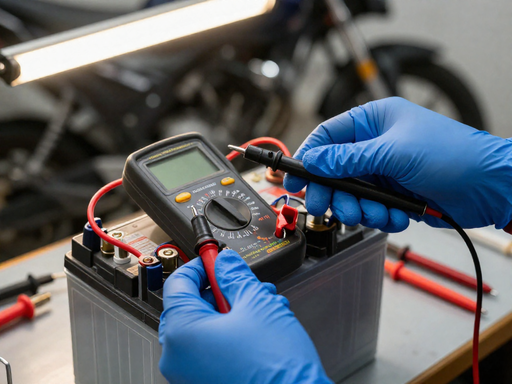
A digital multimeter (less than RM30 at most hardware stores) is your best friend. Set it to DC voltage (20V range).
Resting voltage test - Park the bike and leave it untouched for at least an hour, or overnight if possible. - Touch the red probe to the positive (+) terminal and black to negative (-). - A healthy, fully charged battery should read around 12.6V to 12.8V. - 12.4V = about 75% charged, still okay but worth recharging. - 12.0V = only 25% capacity left, definitely charge it soon. - Below 11.8V = the battery is deeply discharged and may be damaged.
Cranking voltage test - Connect the multimeter, start the engine, and watch the display. The voltage will dip while the starter motor spins. It should not drop below about 9.5V–10V. A fall below 9V means the battery is weak or has a bad cell. If the bike struggles to start and the voltage plunges, the battery likely needs replacing.
Charging system check - With the engine running at a steady idle, the voltage should climb to 13.5V–14.5V. This shows the alternator/magneto is charging the battery. If it stays around 12.6V or lower, there's a charging-system problem, not just a bad battery. Rev the engine slightly (up to 3,000–4,000 rpm) – the reading should remain stable in the same range.
3. Optional: load test
If you can get your hands on a cheap resistive load tester (sometimes found at accessory shops), it applies a controlled load similar to starting. A good battery will maintain voltage above 10.5V for 10–15 seconds. If it drops quickly, it's time to shop for a new one.
4. Is it the battery or the charging system?
A few symptoms point to different culprits. - Battery dies after a full charge, but the charging voltage is normal → The battery can't hold a charge anymore (sulfation or internal short). Replace it. - Brand-new battery keeps going flat → Check for a parasitic drain (alarm, USB charger, or clock drawing power when the bike is off) or a faulty regulator/rectifier. - Headlights dim when revving drops → Charging system is struggling at low RPM; the regulator or stator may be weak.
Remember, frequent deep discharges (like leaving your lights on or many short trips) shorten a battery's life dramatically. By catching issues early with these simple tests, you can avoid getting stranded and extend your battery's service in Malaysia's demanding climate.
Pro Maintenance Tips to Make Your Battery Last Longer
Taking a few minutes each month to care for your battery can add months or even years to its life. Start by cleaning the terminals every couple of months—mix baking soda with water, scrub away corrosion with a wire brush, and once dry, apply a thin layer of petroleum jelly. This prevents the corrosive buildup that worsens in our humid Malaysian weather.
Make sure your battery is firmly clamped in its tray. Vibration from bumpy roads can rattle the internal plates loose, leading to premature failure. For those using conventional wet-cell batteries, check the electrolyte level regularly and top up only with distilled water; never use tap water, as minerals can damage the cells.
If your bike sits idle for more than a week—maybe during a long break or the monsoon season—plug in a smart trickle charger. These maintain a full charge without overcharging, so your battery is always ready to go. Finally, try not to let your battery drain below 50%. Deep discharges strain the chemistry and significantly shorten its lifespan. If you notice slow cranking, recharge it as soon as possible.
When to Replace Your Battery and How to Choose the Right One
Even with careful maintenance, every battery reaches the end of its useful life. Knowing when to replace it and picking the correct replacement will save you from being stranded.
When Is It Time for a New Battery?
- Age: If your battery is more than three years old, it is living on borrowed time. Malaysian heat accelerates chemical degradation, so even a well-kept battery may struggle beyond this point.
- Fails a load test: After a full charge, the voltage should stay above 12.4V. If it drops quickly when you turn on the ignition or crank the engine, the battery likely has a dead cell. Most bike shops can perform a free load test if you are unsure.
- Won’t hold charge overnight: A healthy battery should start the engine easily after sitting. If you charge it fully in the evening and it is weak the next morning, internal damage is likely.
Types of Motorcycle Batteries
Malaysian riders have several options, each with pros and cons:
- Conventional lead‑acid (wet): The most affordable (often RM30–60). These require periodic topping up with distilled water and are prone to spilling if the bike tips over. Best for riders who don’t mind a little hands‑on care.
- Maintenance‑free (MF): Sealed and spill‑proof, with no need to add water. A popular upgrade for daily commuters, typically priced between RM50 and RM120.
- Gel or AGM (absorbent glass mat): Even more vibration‑resistant and longer‑lasting. They cope well with Malaysia’s heat and stop‑start traffic. Expect to pay RM80–200+.
- Lithium (LiFePO4): Extremely lightweight and packed with cranking power, but sensitive to over‑discharge and more expensive (RM150–400+). Ideal for enthusiasts who want to shave weight and don’t mind a higher initial cost.
Finding the Right Size
Always match the battery to your bike’s specifications. The easiest method:
- Check your owner’s manual, or
- Look at the model number printed on your current battery (common codes include YTX7L‑BS, YTZ10S, or GTX9‑BS).
The number indicates physical dimensions, terminal layout, and capacity. Using the wrong size can lead to poor fit, electrical issues, or even damage.
Where to Buy in Malaysia and What to Expect
- Local motorcycle shops: Most carry popular battery sizes and will often handle disposal of your old unit. They can also test the charging system to rule out other problems—useful if you are not confident with DIY diagnostics.
- Online platforms (Shopee, Lazada): You will find a wider range of brands and types, often at competitive prices. Stick to sellers with high ratings and genuine reviews. Pay attention to warranty terms (usually 3–6 months for conventional, up to 12–24 months for premium AGM or lithium).
- Price reminder: Budget around RM30–60 for a basic wet battery, RM50–120 for a quality MF unit, and more for AGM or lithium. Always dispose of your old battery responsibly—most shops will accept it for recycling.
Special Tips for Scooter Riders: Battery Location and Care
Scooter batteries can be surprisingly elusive because they’re often tucked away in less obvious spots to save space. Knowing exactly where yours lives is the first step to hassle‑free maintenance.
Common hiding spots
- Under the seat: This is the most convenient location. Lift the seat and you’ll usually find a plastic cover secured by a few bolts or clips. Remove it and the battery is right there.
- Inside the floorboard: On many classic‑styled scooters, the battery sits beneath a removable panel in the footwell. You may need to pop out a rubber mat and unscrew a small hatch.
- Behind the front panel: Some modern models stash the battery near the headlight or glove box. Access often requires removing a few trim pieces—no special tools, just patience.
Accessing it safely
Always switch off the ignition and remove the key before you start. For under‑seat batteries, you might need to lift out the storage bucket; keep track of any screws or fasteners. Floorboard‑mounted batteries sometimes have a quick‑access cover, but if you’re unsure, a quick glance at your owner’s manual will prevent broken clips. Front‑panel batteries may involve wiggling the panel free—work gently and don’t force anything. If the location feels overly complicated, a trusted mechanic can show you the trick in two minutes.
Twist‑and‑go scooters without a kickstart
Most modern scooters rely entirely on the electric starter, so a flat battery means you’re stranded. Without a kickstart lever, you can’t just stomp it to life. Make it a habit to check your battery voltage monthly with a simple multimeter. A healthy, fully charged battery should read around 12.6 V or higher with the ignition off. If you notice it dipping below 12.2 V, charge it soon. Consider carrying a compact lithium jump starter under the seat—it’s a lifesaver when a weak battery sneaks up on you. And if your scooter has a voltmeter built into the dash, glance at it before setting off; a reading below 12 V while idling often hints at trouble.
Knowing your scooter’s layout and giving its battery a little regular attention goes a long way toward avoiding the dreaded silence when you thumb the starter.
FAQ
How do I know if my motorcycle battery is completely dead?
A completely dead battery usually shows no dashboard lights, no starter crank, and a voltage reading below 11.8V at rest on a multimeter; under 10.5V often means it’s deeply discharged or faulty. Physical signs like a swollen case or heavy corrosion also indicate it’s time for a replacement.
Can I use a car battery charger for my motorcycle battery?
Yes, but only if the charger has a low-amp setting (2 amps or less) to avoid overheating and damaging the smaller motorcycle battery. Many modern smart chargers can automatically adjust, but always check your battery type (lead-acid, AGM, or lithium) and the charger’s specifications to prevent overcharging.
Why does my battery die after a few days of not riding?
It’s often caused by parasitic drain from accessories like alarms, GPS trackers, or USB chargers that stay powered when the bike is off. In Malaysia’s hot climate, batteries also self-discharge faster, and a faulty regulator/rectifier or an aging battery can make the problem worse.
Is it safe to jump-start a motorcycle?
It can be safe if done carefully: use a portable jump starter or a car with the engine off, connect positive to positive and negative to a grounded metal part on the bike, and never let the terminals touch. Avoid jump-starting from a running car engine, as the higher voltage can damage your motorcycle’s electronics.
How much does a new motorcycle battery cost in Malaysia?
A basic lead-acid battery for a kapcai scooter typically costs around RM40–80, while a good AGM or maintenance-free battery for a larger bike ranges from RM150–300. Premium lithium batteries can exceed RM500, and prices vary by brand and retailer, so check local workshops or online platforms like Shopee and Lazada for current deals.